What you license · 01
The Delivery OS
The operating system for how an organization turns strategy into delivered value: one connected system where work is chosen on evidence, planned at honest capacity, visible at every level, and measured for the value it actually returns.
When plans live in slide decks, priorities in spreadsheets, status in meetings, and delivery in a separate tool, the connections between them exist only in people’s heads, and keeping the picture current becomes its own job. The Delivery OS gives all of that effort one home. The strategy, the portfolio, the plan, the work in flight, and the outcomes live as connected records in a single system, so the picture assembles itself, decisions carry their reasoning with them, and the energy once spent reconstructing the truth goes into acting on it.
The big picture
Three altitudes, one thread, three reads.
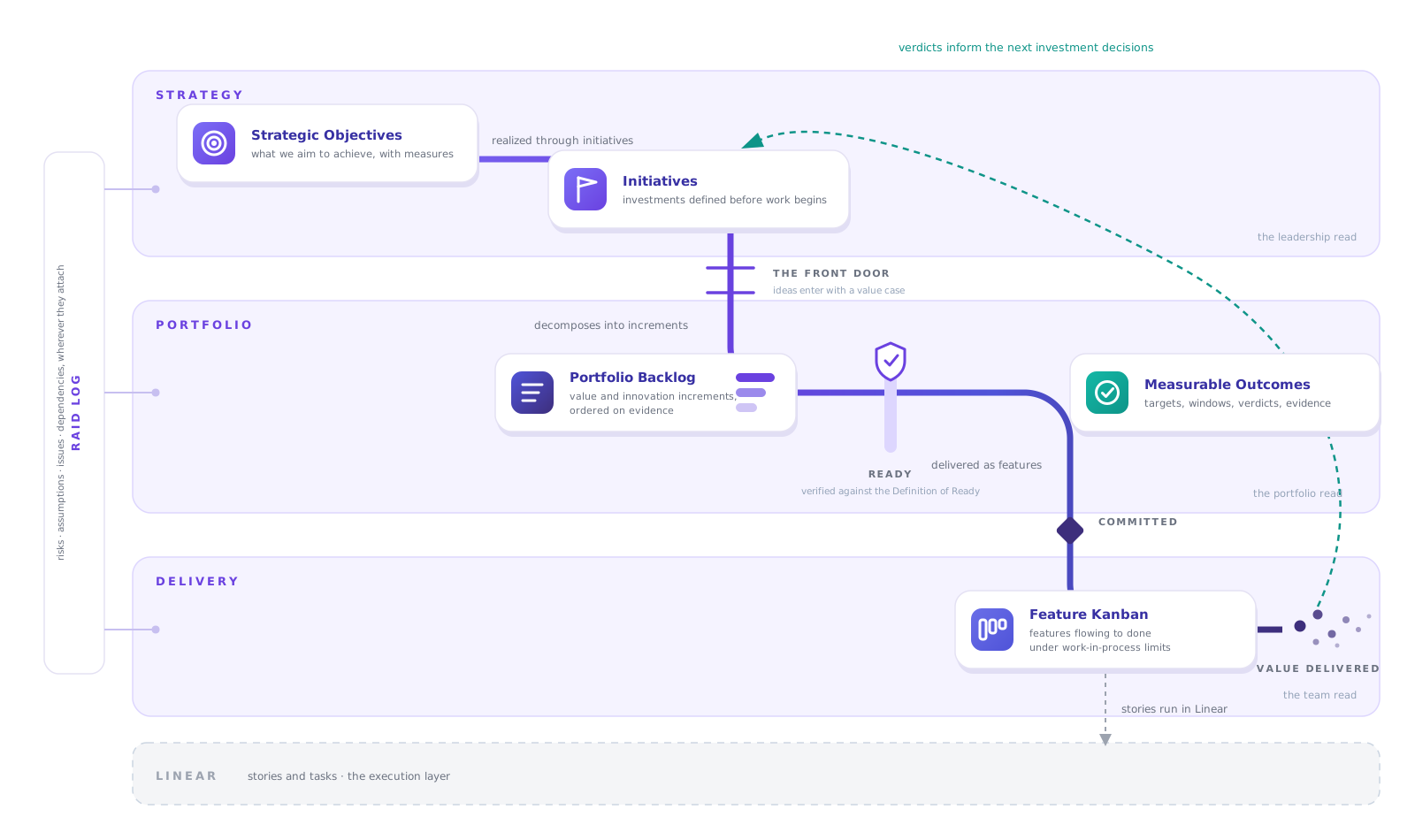
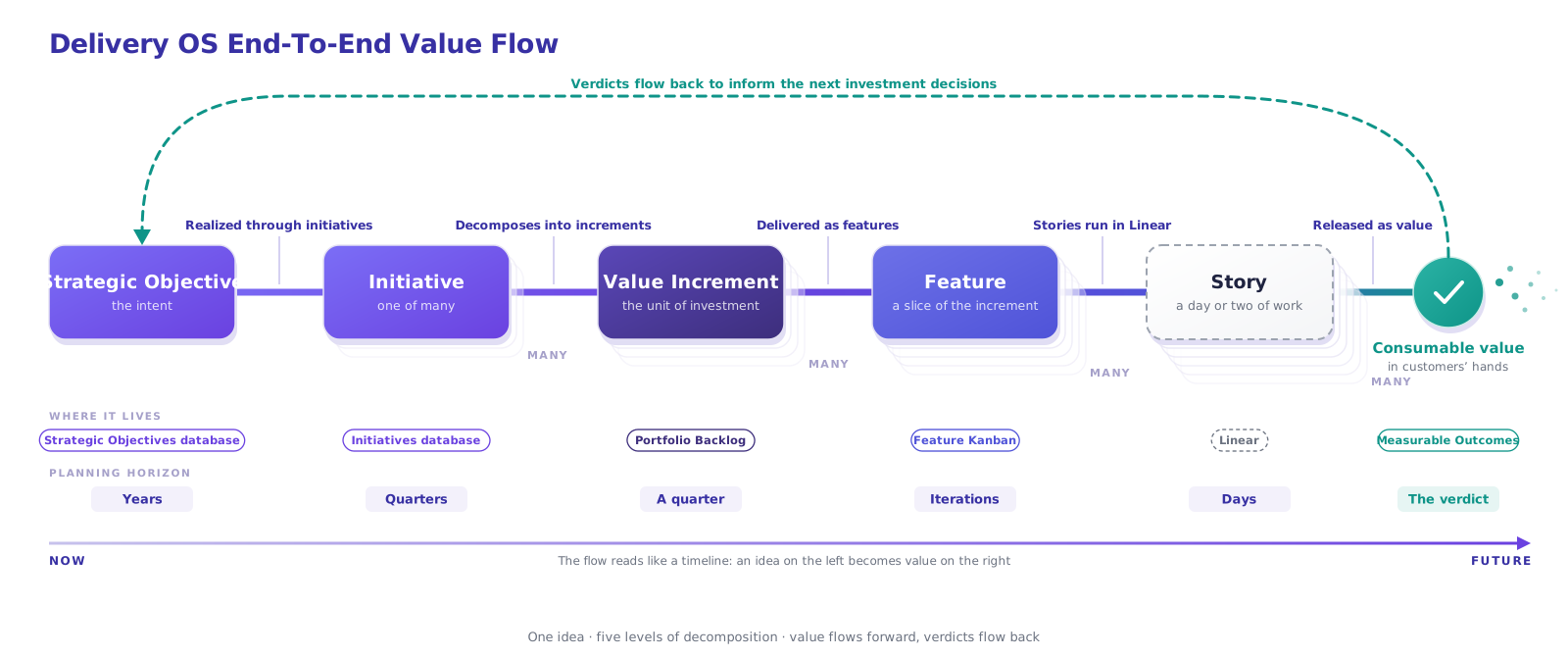
Strategy decomposes downward and evidence rolls upward. A strategic objective names what the year must change. An initiative is the strategic bet that serves it, defined to an eight-category standard before work begins. An increment is the unit of commitment, ordering, and flow measurement: what a planning event pulls, what the monitor watches, and what carries outcomes. A feature is the unit of construction inside an increment, mirrored to Linear where stories live. A measurable outcome is the unit of proof.
The design
Connected records, not copied ones.
The Delivery OS is built as a set of connected databases that together carry the full life of the work. Four of them form the altitude ladder: Strategic Objectives hold what the organization is trying to achieve and the measures that will prove it; Initiatives hold the substantial investments that advance those objectives; the Portfolio Backlog holds value and innovation increments, the units in which the organization actually invests; and the Feature Kanban holds the features those increments decompose into as they approach delivery. Two more cut across every level: the RAID Log carries risks, assumptions, issues, and dependencies wherever they attach, and Products and Assets map every piece of work to the products it touches. Measurable Outcomes is where the system holds the results it promised, each outcome its own record with its measure, baseline, target, data source, and measurement window. Beside them sit the capacity model, the capacity allocations that let a planning event commit and release a team’s share in one act, the Teams register, and the Metrics Registry.
What makes this a system rather than a set of lists is that the records are related, not copied. An increment points to its initiative, an initiative to its objective, a feature to its increment, so traceability is a property of the data itself. Below the Feature Kanban sits Linear as the execution layer, where stories and tasks live and teams run their iterations, with a deliberate mirror between the two so the board’s story and the teams’ reality stay reconciled.
Design principles
The rules the instrument is built on.
One truth per tool
Linear owns execution truth, GitHub owns code-flow truth, and Notion owns economic and strategic truth: value scores and their vintage, cost of delay, complexity, ordering, outcomes and verdicts. Nothing is duplicated and nothing is cached that a skill can read live.
Time is stamped by automations, never by hands
Database automations stamp the dates nearly the entire threshold register computes from: backlog aging, discovery aging, blocked duration, flow debt, both cycle-time segments, throughput, and value realization lag. No human maintains a timestamp anywhere in the system.
Judgments land where they are made
Every facilitation skill carries a property decision round. Complexity, cost of delay, and the accountable business owner enter the schema at the moment the judgment is made, with provenance stamped as a side effect, so nobody does data entry after the fact.
Properties are for filtering; pages are for reading
A property earns its place when a view, monitor, threshold, or skill filters, groups, sorts, or computes on it. Outcomes prose, acceptance criteria, non-functional requirements, and release strategy live in the page body, and prose never duplicates a table.
One vocabulary per concept
Quarters always carry years, one health signal per database, one name per concept across the databases and the guidance pages, so a question asked anywhere gets the same answer.
Exception-based by design
Daily reads against a ratified threshold register surface only what is aging, blocked, or drifting, each exception with an owner and a drafted next step. The system makes work visible, not people.
Ten attributes
What the system guarantees, stated once.
- Strategic alignment. Every piece of work traces upward to a named strategic objective, so nothing enters without a line of sight to strategy.
- End-to-end traceability. One unbroken thread runs from objective to initiative to increment to feature to story, spanning the management system and the execution tool.
- Visualization at every level. Boards and timeline views exist at the portfolio, initiative, increment, and feature levels, so the state of work is seen, not assembled.
- Value-sliced work. Work is cut into value and innovation increments that each deliver a measurable outcome, rather than phases or projects that deliver documents.
- Pull-based flow. An intake queue with an explicit buffer, portfolio work-in-process limits, and classes of service mean work is pulled when capacity exists, never pushed.
- Evidence-based ordering. The backlog is sequenced on Cost of Delay, value scoring, and recorded rationale, so an ordering can be inspected and challenged on its merits.
- One truth, three reads. A single dataset sits behind role-tailored views, so leadership, portfolio management, and teams read the same reality at different altitudes.
- Exception-based monitoring. Daily reads against a ratified threshold register surface only what is aging, blocked, or drifting, with each exception owned and its next step drafted.
- Cadenced, living planning. Quarterly planning, monthly refinement, and triggered mini-planning keep the plan true instead of letting it go stale between big events.
- Measured value realization. Outcomes carry targets and data sources from the day they are defined, and value is confirmed after delivery, closing the loop the strategy opened.
The flow
Work enters through one door and leaves as a recorded verdict.
An idea arrives with its problem, intended result, and value case stated, which is enough for screening but far from enough for commitment. Ideas worth pursuing move into the Discovery Workflow, where they are developed until they meet the Definition of Ready, and then wait in the intake queue, a buffer deliberately held to a depth that matches quarterly capacity. Each increment carries a value score and Cost of Delay reasoning, monthly Portfolio Backlog Refinement keeps the sequence current with the rationale for every move recorded, and each quarter Value Delivery Planning turns the top of the ordered queue into a commitment made at honest capacity. Committed increments flow through delivery as features cross the Feature Kanban and stories move through Linear under work-in-process limits. Then the loop closes: as each outcome’s measurement window ends, the result is reviewed against its target, a verdict is recorded with the evidence behind it, and those verdicts feed the next quarter’s ordering.
See it running
The Delivery OS as BigBank, end to end.
One increment, traced both ways
From a BigBank strategic objective down to a sized story in Linear and back up to the outcome it serves, with the verdict recorded where the next ordering decision can read it.
What the license contains
The system itself, and everything needed to keep it true.
The Delivery OS design specification, which is the arbiter of the schema, with the property-level reference as its companion: every database, every property with its purpose and the view, monitor, or skill that consumes it, the canonical board states, the automation recipes, and the relations map.
The configured views and the dashboard faces built over them, the threshold register seeded as proposals the way the methodology prescribes, and the Notion-to-Linear workflows for initiatives, increments, features, and stories, each with its data contract.
The Delivery OS runs in production on Notion and Linear and is installable on Jira and Confluence or other combinations, because the specification describes the system rather than any one tool’s configuration. The license carries the specification; the installation carries it onto your stack.
The written guidance that explains how each part is meant to operate ships beside it as the PDLC, and the skills that operate the working rhythm load that guidance as their instructions. How the tiers are shaped.